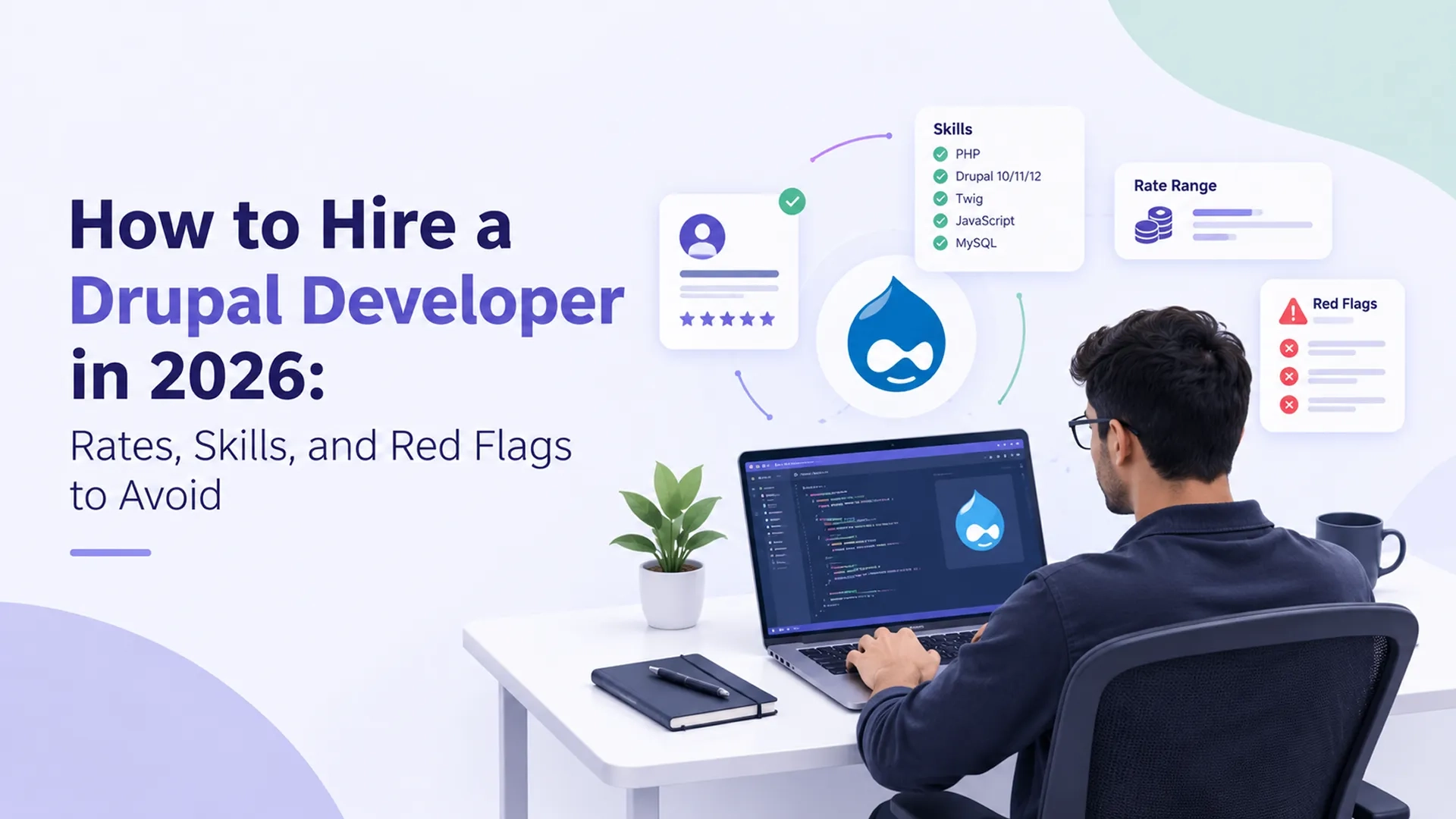
How to Hire a Drupal Developer in 2026: Rates, Skills, and Red Flags to Avoid
 October 5, 2026
Most businesses hiring a Drupal developer for the first time make the same mistake.
They pick the cheapest option. Or the fastest to respond. Or the one with the most impressive-sounding proposal.
Six months later, they are paying someone else to fix what the first developer built.
We wrote this guide because we have seen it happen too many times.
Why Hiring a Drupal Developer Is Harder Than It Looks
Drupal is not WordPress. You cannot hand a project to someone who has dabbled in PHP and expect a solid outcome.
Drupal 11 requires genuine expertise in content architecture, configuration management, module development, and API integration. The gap between a developer who knows Drupal and one who understands it is enormous — and that gap shows up directly in your project timeline, your budget, and the long-term health of your site.
There are thousands of developers who list Drupal on their profiles. Far fewer of them can architect a site that performs under real traffic, integrates cleanly with your CRM, and stays maintainable two years from now.
Knowing the difference before you hire is what this guide is about.
What Real Drupal Expertise Looks Like in 2026
Before you evaluate anyone, understand what you are actually looking for.
A strong Drupal developer in 2026 should be working with Drupal 10 or 11 specifically — not citing years of experience on older versions as a substitute. The platform has changed significantly. Experience on Drupal 7 or 8 does not automatically transfer to Drupal 11 architecture.
Beyond version knowledge, look for these specific competencies:
Content architecture and entity modeling
This determines whether future changes to your site require a quick configuration update or an expensive rebuild. A developer who thinks carefully about content structure upfront saves you significant money later.
Configuration management via YAML and version control
This is non-negotiable in professional Drupal work. Any developer who makes changes directly in a production admin panel, rather than through a proper deployment pipeline, is creating risk for your project.
Custom module development
Contributed modules solve most problems, but knowing when to build custom and when to use what exists is a judgment call that separates senior developers from juniors.
API and third-party integration
Modern Drupal sites connect to CRMs, payment gateways, analytics platforms, and marketing tools. Your developer needs to be comfortable building and maintaining these connections.
AI module familiarity
Most Drupal developers haven't caught up with Drupal's AI initiative yet. Someone who already has is worth more than their rate suggests — and increasingly, it's the kind of thing that separates a developer who is keeping up with the platform from one who isn't.
Drupal Developer Rates in 2026: What to Expect
Rates vary significantly by region and engagement type. Here is a current market breakdown:
| Region / Type | Rate (2026) |
| North America / Australia — Freelancer | $40–$65 per hour |
| Asia — Freelancer | $20–$35 per hour |
| UK — Agency day rate | £600–£900 per day |
| UK — Senior contractor | £550–£750 per day |
| Europe nearshore | £250–£400 per day |
These headline numbers mask the real cost. Onboarding time, management overhead, and quality variations all affect what you actually spend.
A word of caution on cheap quotes. A developer charging $15 per hour may complete the project. They may also deliver code that costs you $30,000 to fix 12 months from now. The question is never what a developer costs. It is what the wrong developer costs.
Four Questions to Ask Before Hiring Anyone
These are not technical tests. They are judgment checks. How a developer answers them tells you more than their portfolio.
1. How do you move configuration changes to production?
The right answer involves YAML exports, version control, and a deployment pipeline. The wrong answer involves clicking through the admin panel on the live site.
2. When would you build a custom entity instead of using a standard node?
There is no single correct answer, but a strong developer will walk you through the trade-offs clearly. Vague or confused answers are a warning sign.
3. How do you evaluate whether to use a contributed module or write custom code?
The answer matters less than the reasoning. You want someone who thinks about maintainability, security history, and community support — not just what gets the feature built fastest.
4. Walk me through a major Drupal version upgrade you have completed.
Drupal 10 reaches end of life on December 9, 2026. If you are on Drupal 10, you need someone who has done this before, not someone who will learn on your project.
Red Flags That Should End the Conversation
There are signals that, once you see them, should stop any hiring process immediately:
A developer who cannot clearly explain configuration management. This is fundamental. If they cannot answer it confidently, they are not working professionally.
A developer who has not touched Drupal 10 or 11. With the December 2026 EOL deadline, someone working primarily in older versions is already behind.
A developer who quotes a fixed price without asking detailed questions first. Legitimate Drupal work requires scoping. Anyone who quotes immediately is guessing — and you will pay for that guess later.
An agency with no verifiable case studies or client references. Portfolios are easy to fabricate. References are not.
Unusually fast delivery timelines. Complex Drupal builds take time. Rushed builds create technical debt that costs more to fix than the time saved.
Freelancer vs Agency: Which Is Right for Your Project?
The honest answer is that it depends on what you are building and how much risk you can absorb.
| Freelancer | Agency | |
| Best for | Clearly scoped, standalone tasks | Complex, ongoing, or high-risk projects |
| Cost | Lower hourly rate | Higher — but team continuity included |
| Risk | Single point of failure | Team absorbs staff changes |
| Speed (2026 EOL) | Limited capacity for fast migrations | Can run migrations at pace |
| Long-term support | Depends on availability | Built in |
One thing to consider in 2026 specifically: with Drupal 10 reaching end of life in December, many businesses need migration support quickly. Agencies have the capacity to run these migrations at pace. Most freelancers do not.
What the Hiring Process Should Actually Look Like
Start with a detailed requirements brief, not a vague request for proposals. The more specific you are about what you need, the more accurate the responses you will receive and the easier it becomes to compare them properly.
Request case studies relevant to your industry or project type. A developer who has built government portals thinks differently from one who has built e-commerce platforms. Both are valid, but relevance matters.
Run a small paid test before committing to a full engagement. A two-hour task that mirrors the actual work tells you more about a developer than any interview.
Check references. Not LinkedIn endorsements. Actual conversations with previous clients about what the experience was like, what went wrong, and how the developer handled it.
And if you are evaluating multiple agencies, ask each of them the four questions above. The quality of the answers will make your decision easy.
Common Questions — Answered Directly
How much does it cost to hire a Drupal developer in 2026?
Freelancers in North America and Australia typically charge $40–$65 per hour. In Asia, rates generally fall between $20 and $35 per hour. UK agency day rates run £600–£900 per day. These rates reflect the developer's hourly cost, not the total project cost — which depends on scope, complexity, and how well requirements are defined upfront. The cheapest developer is rarely the most cost-effective choice.
What skills should a Drupal developer have in 2026?
Specific Drupal 10 or 11 experience, configuration management via YAML and version control, custom module development, API integration, and an understanding of Drupal's content entity system. Bonus: familiarity with Drupal's AI modules, which are becoming increasingly relevant as the platform's official AI initiative expands.
Should I hire a Drupal freelancer or an agency?
Freelancers work well for clearly scoped, standalone projects. Agencies make sense when the project is complex, requires multiple skill sets, or when continuity matters — especially for sites where downtime or developer loss would cause real business problems. Given the December 2026 Drupal 10 EOL deadline, agencies have more capacity to run migrations quickly.
How do I know if a Drupal developer is good?
Ask them the four questions in this guide. Specifically: how they handle configuration management, when they'd build a custom entity versus a standard node, how they evaluate contributed modules, and to walk you through a major version upgrade they've completed. The quality of the answers tells you more than years of experience or a portfolio.
What is Drupal 10 end of life and does it affect hiring?
Drupal 10 reaches end of life on December 9, 2026. After that date, there are no more security patches or official support. Any developer you hire for a Drupal 10 site should have experience with Drupal 11 migration — because that work needs to happen before the deadline, not after. A developer who is not familiar with the migration path is a liability at this point in the calendar.
What are the biggest mistakes businesses make when hiring Drupal developers?
Choosing based on price alone. Hiring without checking references. Not running a small paid test before committing. Accepting vague proposals without detailed scoping. And not asking how the developer handles configuration management — which is one of the clearest signals of professional versus amateur Drupal work.
Drupal Developer Hiring Checklist — Quick Reference
Confirm they have specific Drupal 10 or 11 experience — not just general Drupal
Ask how they move configuration changes to production
Ask when they would build a custom entity versus a standard node
Ask how they evaluate contributed modules
Ask them to walk through a major version upgrade they have completed
Request relevant case studies — not just a general portfolio
Run a small paid test before committing to a full engagement
Check references with actual previous clients
Walk away from anyone who quotes a fixed price without detailed scoping
Walk away from anyone not familiar with the Drupal 10 EOL deadline and migration path
For complex or ongoing projects — consider an agency over a freelancer
Not sure where to start, or want a team that can answer every question in this guide without hesitating?
Tell us what you are building. We will tell you exactly what it takes.
Contact Us → drupalify.com/contact

Dixit Patel
Web Developer & BloggerI write about web development, programming tips, and Drupal Commerce solutions. Follow me for tech tutorials and updates.

Struggling with
Let Us Audit Your Website for Free & Share Actionable Fixes