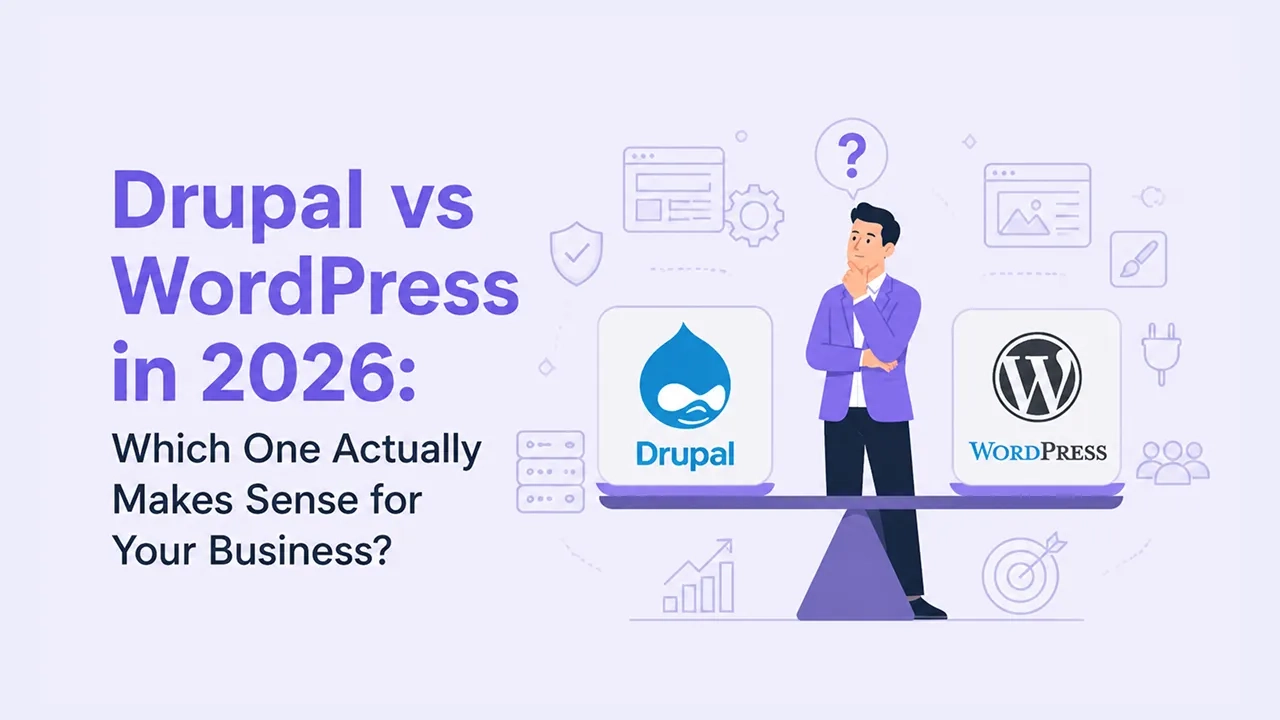
Drupal vs WordPress in 2026: Which One Actually Makes Sense for Your Business?
 May 4, 2026
Every few months, someone asks us this question.
Usually, it's a CTO who's frustrated with their current setup. Sometimes it's an IT Director who's been told to "just use WordPress" by someone who's never had to maintain a complex site at scale.
Here's our honest answer — not the SEO-optimized one.
They're built for different things.
WordPress was built for publishing. It's fast to set up, easy to use, and has a plugin for almost everything. For a marketing site or a simple blog, it's genuinely excellent.
Drupal was built for complexity. Multiple content types, complex user roles, strict security requirements, multilingual sites — this is where it earns its reputation.
Neither is universally better. One is probably a better fit for what you're building.
Security
This is where the gap is most obvious.
Drupal has a dedicated security team. It issues coordinated advisories. It enforces secure coding standards at the framework level. Healthcare organizations and government agencies don't choose Drupal because it's trendy — they choose it because their compliance requirements demand it.
WordPress core is fine. The problem is the plugins. Most WordPress hacks don't come through core — they come through an outdated plugin that nobody noticed needed updating. When you have 40 plugins running on your site, that's 40 potential entry points.
For a business blog, this is manageable. For a site handling patient records or financial data, it's a different conversation entirely.
Scalability
WordPress scales content well. Thousands of pages, products, blog posts — no problem.
Drupal scales complexity well. Intricate content relationships, enterprise integrations, personalization across user roles — this is what Drupal's architecture was designed for.
In 2026, the move toward headless and API-first architecture has made this gap more visible. Drupal handles decoupled setups cleanly. WordPress can do it, but it takes more effort to get it right.
Cost — the number people calculate wrong
WordPress is cheaper to build. More developers know it, plugins cover a lot of ground, and setup is faster.
Drupal costs more upfront. Custom development is more common.
But look at three to five years out, and the picture often changes.
WordPress sites tend to accumulate technical debt — plugin conflicts, performance issues, security incidents. A single breach on an unpatched WordPress site can cost more than the entire original build.
Drupal's maintenance is more predictable. The architecture holds up better over time.
If you're a startup building a simple site, WordPress's lower upfront cost makes sense. If you're an enterprise making a multi-year platform decision, run the full numbers before assuming WordPress is cheaper.
Who should use WordPress?s
- You need a marketing site or content hub up quickly
- Your team is non-technical and manages content daily
- Your requirements are straightforward
- Budget is a primary constraint
Who should use Drupal
- You're in healthcare, government, education, or finance
- Your site has complex content, workflows, or user roles
- You need multilingual support across many languages
- You're planning a headless or API-first architecture
- You're making a long-term platform decision and want to avoid technical debt
The real question
Most organizations that come to us didn't choose the wrong platform because they made a bad decision. They chose it because their requirements changed — and the platform didn't grow with them.
If you're not sure whether what you have is built for where you're going, that's exactly what our free audit covers.
We look at your current setup, your requirements, and give you a straight answer. No sales pitch. Just a clear picture of where things stand.

Dixit Patel
Web Developer & BloggerI write about web development, programming tips, and Drupal Commerce solutions. Follow me for tech tutorials and updates.



Struggling with
Let Us Audit Your Website for Free & Share Actionable Fixes