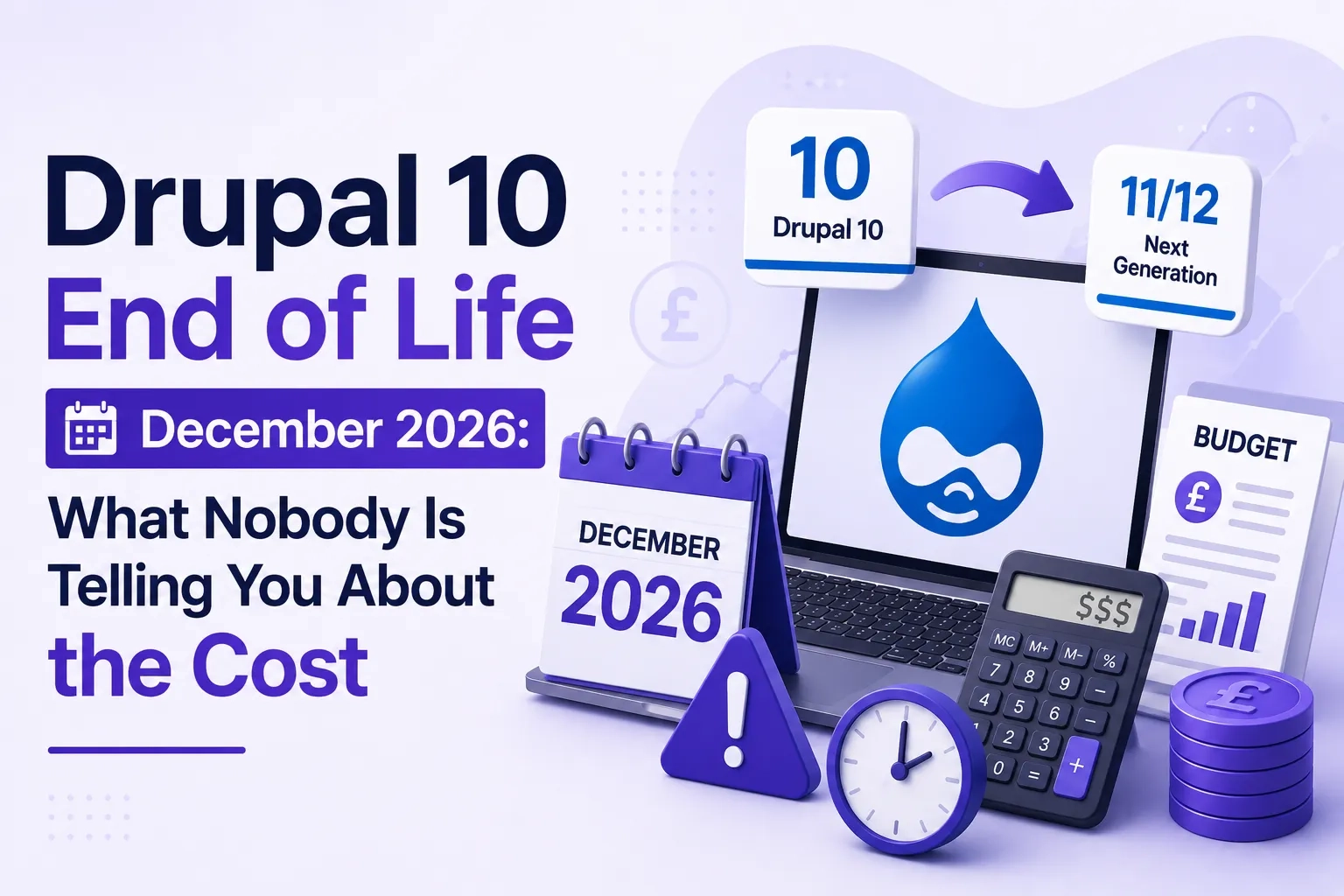
Drupal 10 End of Life December 2026: What Nobody Is Telling You About the Cost
 July 20, 2026
December 9, 2026. That’s the date Drupal 10 loses security support. Most organizations know it. Most are waiting.
Here’s what nobody is saying clearly: every week you wait after July makes this migration more expensive. Not in a vague “tech debt” way. In a very specific “agencies are booked and priced accordingly in Q4” way.
This guide covers what the upgrade actually costs by site type, why Q4 is the worst time to start, and what a realistic month-by-month plan looks like — with verified numbers, not estimates.
What Drupal 10 End of Life Actually Means
Drupal 10 reaches end of life on December 9, 2026. Drupal 12 ships the week of December 7, 2026. After December 9, the Drupal Security Team will not issue patches for Drupal 10 core or contributed modules. Any vulnerability discovered after that date has no official fix.
That’s not a hypothetical. It’s exactly what happened with Drupal 7, which reached end of life on January 5, 2025. Within months of that date, sites still running Drupal 7 were carrying open CVEs with no patches coming — permanently.
Some earlier Drupal 10 branches have already lost support. Drupal 10.5 lost security coverage on June 17, 2026. If you’re still on 10.5.x, you’re already running without patches.
And if you’re still on Drupal 7, 8, or 9 — those versions have been end-of-life for years. The December 9 deadline doesn’t apply to you because you’ve already passed it.
What the Upgrade Actually Costs in 2026
The most common question we get: “how much does Drupal 10 to Drupal 11 upgrade cost?” The honest answer depends entirely on what’s on your site. Here’s what agencies are actually quoting:
Site Type | Typical Cost | Timeline |
Light site (under 50 pages, few contrib modules) | $15,000 – $35,000 | 4 – 6 weeks |
Mid-market site (50–200 pages) | $35,000 – $90,000 | 8 – 12 weeks |
Enterprise (multisite, headless, heavy custom code) | $90,000 – $250,000+ | 12 – 20 weeks |
These are standard rates for H1 and H2 2026. Q4 is different.
The Q4 Premium Nobody Warns You About
Every Drupal agency in the market right now knows that demand compresses in October, November, and December 2026. There’s a fixed deadline everyone can see, and most organizations are planning to act on it at the last possible moment.
What that means in practice: senior Drupal developer availability in Q4 will be constrained, and agencies will price accordingly. Teams that book their migration in July or August pay standard rates. Teams that call in October — if they can get an agency at all — will pay a premium on top of standard rates.
One agency that has been tracking this clearly: “The teams that migrate in August pay normal rates and sleep in December. The teams that wait pay more, rush more, and find out that Q4 is where regressions and SEO accidents happen.”
Beyond agency rates, rushed migrations carry their own hidden costs: insufficient testing time, broken integrations discovered post-launch, SEO disruption from URL structure changes that weren’t mapped properly.
A Realistic Month-by-Month Plan
July — Know What You Have
Run the Upgrade Status module against your production database. This tells you which contributed modules are compatible with Drupal 11 and which aren’t. One day of audit work turns “we think it’s probably fine” into a task list with actual numbers attached.
August — Prepare the Environment
Drupal 11 requires PHP 8.3 or higher. If your hosting platform is on PHP 8.1 or 8.2, that’s a separate upgrade that needs to happen before you touch Drupal. Get environments to PHP 8.3 — local, CI, staging, production — while your production site is still stable on Drupal 10.
September — Fix the Code
Drupal Rector automates most deprecation fixes in custom code. For contrib modules, you have three options: wait for a compatible release, apply a patch from the issue queue, or find a replacement. Triage this list before writing migration code, not during it.
October — Upgrade and Test
Run the Composer upgrade on a staging copy, run database updates, then test with the actual people who use the site daily — not just developers. Keep production on Drupal 10 untouched while staging is being validated.
November — Go Live
Production cutover with a rollback plan in place. Check redirects, metadata, and canonical URLs. Submit your sitemap to Google Search Console immediately. Monitor for crawl errors in the first two weeks.
December — Buffer, Not Plan
If your go-live date is December 8, you have no buffer. December should be the month you have in case something unexpected came up in November — not the month you’re trying to finish a migration.
The Hidden Costs Most Quotes Leave Out
PHP environment upgrade — often not included in migration quotes, can add $2,000–$8,000
Abandoned contrib modules with no Drupal 11 equivalent — each one that needs a custom replacement adds development time
Third-party integrations — Salesforce, CRM, payment gateways often need retesting post-upgrade
Content editor retraining — Drupal 11’s admin interface has changed enough to warrant a training session
SEO recovery if redirects are handled poorly — Google can take 3–6 months to fully reindex after a migration
What Happens If You Don't Upgrade
After December 9, 2026, the specific risks are:
No security patches for any vulnerability discovered in Drupal 10 core after that date
Contributed modules will also stop receiving Drupal-10-specific fixes as maintainers shift focus to Drupal 11 and 12
Hosting providers may drop PHP versions your site depends on, creating compatibility breakage independent of Drupal itself
Cyber insurance premiums for sites running unsupported CMS versions have been running 15–40% higher in 2026
None of these happen the day after December 9. The site doesn’t break on December 10. But each month after that date, the risk accumulates and the cost of eventually migrating gets higher, not lower.
Frequently Asked Questions
Can I go directly from Drupal 10 to Drupal 12?
Not recommended. Drupal 12 ships the week of December 7, 2026. Running a brand-new major version on production the week it releases is not a stable migration strategy. Drupal 11 has been stable since August 2024 and is the right upgrade target for organizations working to the December 2026 deadline.
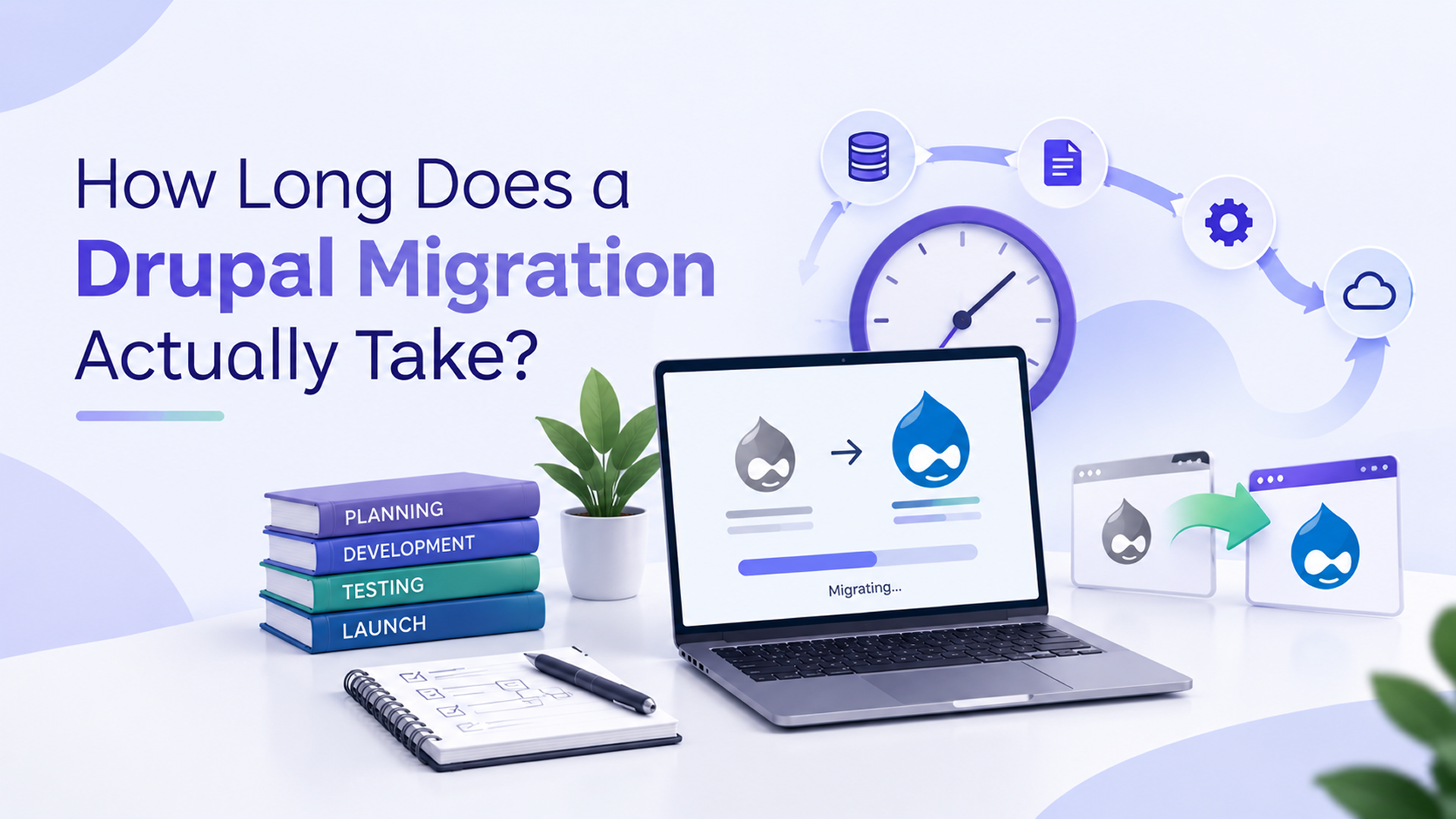
How long does a Drupal 10 to Drupal 11 upgrade actually take?
A light site with few custom modules: 4 to 6 weeks. A mid-market site: 8 to 12 weeks. An enterprise platform with multisite, headless architecture, or heavy custom code: 12 to 20 weeks. These timelines assume the Upgrade Status module has already been run and the scope is understood before work starts.
What if I’m still on Drupal 7, 8, or 9?
Drupal 7 reached end of life January 5, 2025. Drupal 8 reached end of life November 17, 2021. Drupal 9 reached end of life November 1, 2023. The December 9, 2026 deadline is specifically for Drupal 10. If you’re on 7, 8, or 9, you’ve already passed your deadline — the migration is more involved and more urgent.
What is the Upgrade Status module?
A free Drupal contrib module that scans your site and reports which contrib modules and custom code are compatible with the next major version. Every realistic Drupal 10 to Drupal 11 plan starts with running it. Install it, run it against your production database, and use the output as your scope document.
Not sure where your site stands against the December 9, 2026 deadline? We’ll run a free audit and fix one real issue — no charge, no pitch. Just the honest picture of what your upgrade actually involves.
Get your free audit → drupalify.com/contact
Sources: Drupal.org core release schedule (confirmed December 9, 2026 EOL); MetaDesign Solutions, “Drupal 10 End of Life December 2026”; tak.tn, “Drupal 10 end of life: your six-month plan”; TheDropTimes coverage of Drupal 10 EOL planning.

Dixit Patel
Web Developer & BloggerI write about web development, programming tips, and Drupal Commerce solutions. Follow me for tech tutorials and updates.




Struggling with
Let Us Audit Your Website for Free & Share Actionable Fixes